

If you run a business, your website or app is working for you every day. Customers browse it, sign in, place orders and get in touch through it. So when you ask for something new, whether it’s a button, a page or an extra step in checkout, you want it to arrive safely. What you don’t want is for that small addition to quietly break something your customers rely on.
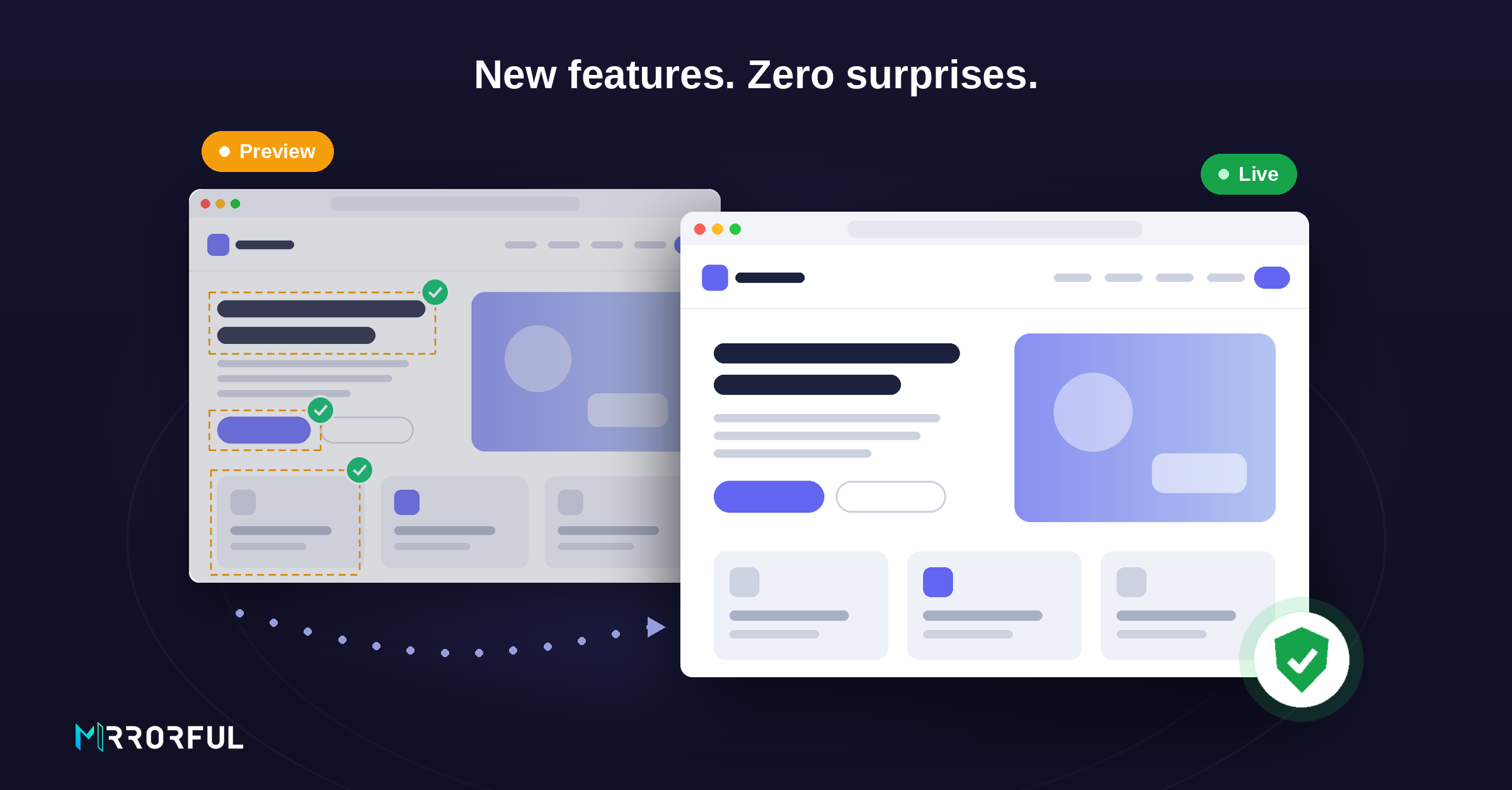
At Mirrorful, we have built our release process around exactly that concern. Every new feature is built on its own, tested on a private preview copy of your site, and reviewed by you before any real customer sees it. Here is how that works, and why we think it matters so much.
Small mistakes shape big impressions
From the inside, a broken link or an unresponsive button can look like a minor bug. From the outside, it looks very different. In its research on how people judge the trustworthiness of websites, Nielsen Norman Group (NN/g) found that “typos, broken links, and other mistakes quickly degrade credibility and communicate an overall lack of attention to detail.”
Your customers can’t see the care and effort behind your product. They only see what is in front of them. When a page comes up blank or a form refuses to submit, they don’t think “that’s a small bug.” They start to wonder whether the business behind it is paying attention, even when it absolutely is.
Errors also have a real business cost. Baymard Institute’s research into why online shoppers abandon their carts found that 17% of US shoppers who had abandoned an order did so because the website had errors or crashed (a figure that sets aside people who were just browsing). That is roughly one in six.
Why the moment of release deserves extra care
Most problems don’t appear out of nowhere. They tend to show up when something changes. Google’s Site Reliability Engineering team puts it plainly: “In Google’s experience, a majority of incidents are triggered by binary or configuration pushes”, in other words, by releasing new code or changing settings.
That doesn’t mean change is bad. New features, fixes and improvements are how every product grows. It does mean that the moment a change goes live is the moment to be most careful. The same Google guidance makes the point that when defects are caught early, users are minimally affected. That idea sits at the heart of how we work.
Our path from idea to live
Every feature we build follows the same calm path:
- Built on its own. The new feature is developed separately, away from your live site, so work in progress never touches what your customers are using.
- Tested on a preview copy. When it’s ready, we deploy it to a private preview (staging) copy of your site, set up to mirror the live version as closely as possible: the same design, the same content structure, the same behaviour.
- Reviewed by you. You open the preview, click through it, try it on your phone and tell us what you think.
- Refined without rushing. We track down and fix every detail that comes up, however small.
- Released with confidence. Only when you and our team are both confident does the feature go live.
Preview environments are a well-established practice in modern web development. Vercel, a widely used hosting platform for modern websites and apps, describes them as a way to “deploy and test changes in a live setting, without affecting your production site.” We apply the same principle to every feature we ship.
Your business keeps running while you review
The best part of this approach is that nothing is put on hold. While you are reviewing a new feature on the preview, your live site carries on exactly as normal. Your customers keep browsing, ordering and getting in touch, without any sign that work is happening behind the scenes.
It also means you can take your time. You never have to rush through a new checkout step late at night or approve something you haven’t properly tried. You see the real feature, in context, before anyone else does, and you help decide when it’s ready.
Trust comes first
This process isn’t about being slow. It’s about being careful with something that is hard to earn and easy to lose. Your customers’ trust takes years to build, and a single broken link at the wrong moment can shake it. A new feature is only worth launching if it makes their experience better, not more uncertain. For us, their trust matters more than any new feature.
That is the standard we hold ourselves to: the best update is the one your customers never had to worry about.
If you are planning a new website, an app, or new features for a product your customers already rely on, we would be glad to hear about it. Get in touch with Mirrorful and we will walk you through how we would approach it, step by step.